

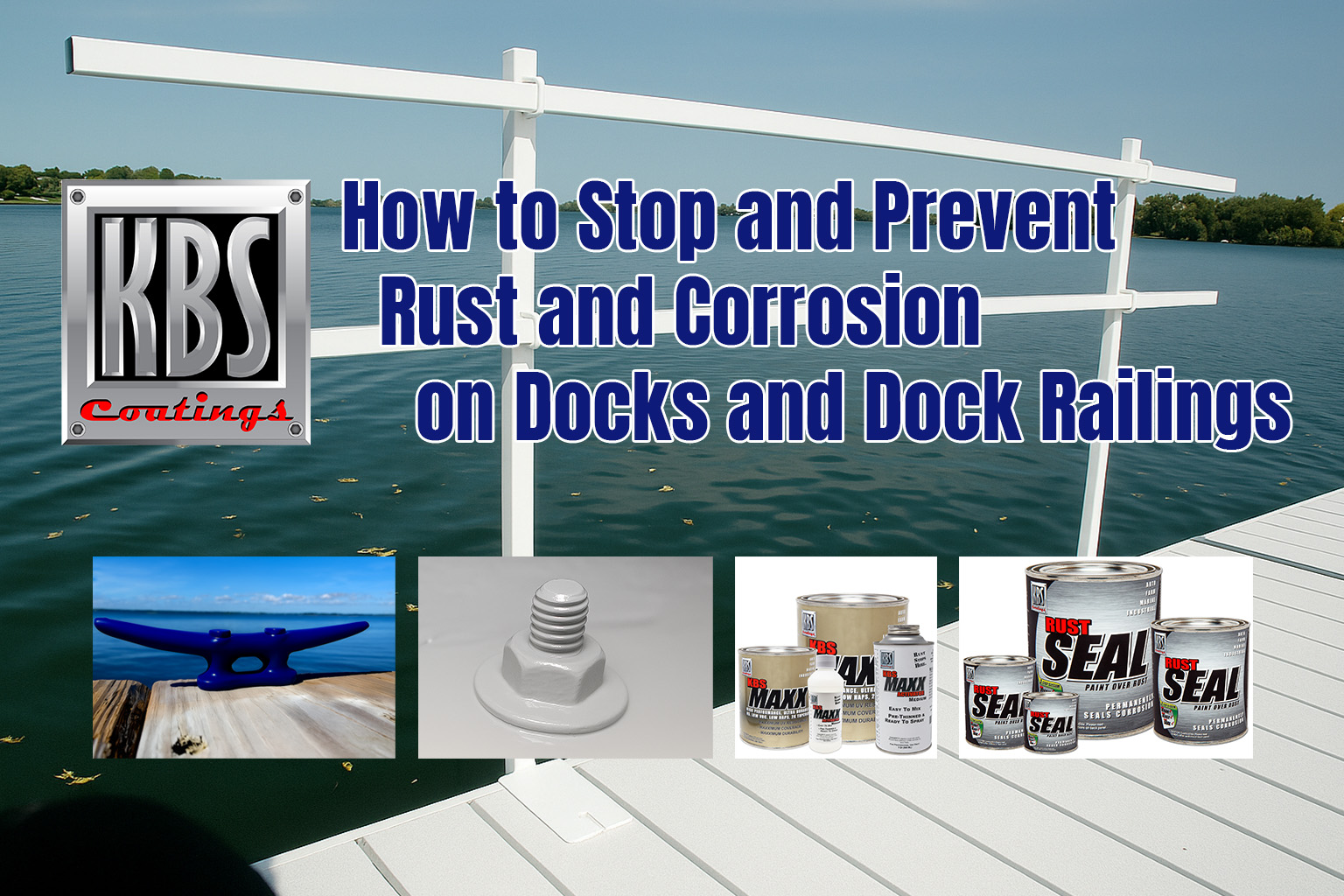
Dock environments are harsh — constantly exposed to water, humidity, sunlight, and wind-driven spray. Metal dock decking and components such as hardware, brackets, railings, and fasteners are in continual contact with moisture, oxygen, and often salt, all of which promote rust and corrosion. If left unaddressed, these conditions can weaken metal over time and lead to loose boards, unstable railings, or structural failure.

Beyond the safety hazards, corrosion also diminishes a dock's appearance and service life. With consistent inspection and proper maintenance using the right coatings, rust and corrosion can be permanently stopped — not just slowed.
In this article, we'll walk through the steps to effectively stop and prevent rust and corrosion on steel and aluminum docks and hardware using KBS Klean, RustBlast, RustSeal, and KBS MAXX.

What Causes Rust on Metal Dock Components?
Rust and corrosion are the natural result of metal oxidation. When steel or iron is exposed to moisture and oxygen, it begins to form iron oxide — commonly known as rust. Aluminum, while more resistant, can also corrode when its protective surface is compromised. In dock environments, this process accelerates due to constant exposure to water and humidity. Even corrosion-resistant metals like aluminum and galvanized steel degrade once their protective coatings are damaged.
Saltwater environments intensify the problem. Salt acts as an electrolyte, speeding up corrosion by allowing electrical current to pass between dissimilar metals. This leads to galvanic corrosion — which occurs when two different metals, such as aluminum railings and stainless-steel fasteners, make contact in a wet environment.
How Can Rust and Corrosion Be Permanently Stopped on Docks?
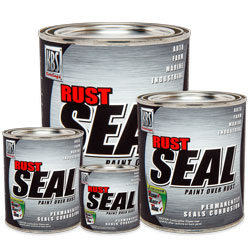
Rust and corrosion can be permanently stopped and prevented by applying RustSeal, a tough 1K moisture-cured urethane coating that creates a permanent barrier sealing metal away from moisture, oxygen, and corrosives like salt. RustSeal dries to a rock-hard yet flexible finish — it doesn't chip or peel, and it can be applied directly to rusted metal, treated metal, or bare metal surfaces.

Do Aluminum and Galvanized Dock Railings Still Need Rust Protection?
While aluminum and galvanized docks, railings, and hardware generally require less maintenance than bare steel, they're not immune to corrosion. In wet environments — and especially saltwater conditions — aluminum and galvanized steel still deteriorate where protective coatings are damaged. It's just as important to coat these metals with RustSeal as it is to coat exposed steel.
Why Is Coating Dissimilar Metals Important on Docks?
Galvanic corrosion is one of the most frequently overlooked aspects of dock maintenance. When two dissimilar metals — such as aluminum railings and stainless-steel bolts — contact each other in the presence of water, one metal becomes the sacrificial anode and corrodes faster. Coating both metals with RustSeal creates an insulating barrier that prevents this electrochemical reaction entirely.
What's the Correct Process for Preparing Metal Before Coating?
Step 1: Remove Loose Rust, Corrosion, and Paint
Start by removing loose rust and paint to create a stable foundation for the coating system.
- Use a wire brush, 320-grit sandpaper, or sandblasting.
- Sandblasting offers the most thorough surface preparation. After sandblasting, RustBlast is not needed — RustSeal can be applied directly to freshly blasted metal handled only with gloved hands. Simply blow off loose dust and proceed.
- Lightly scuff any well-adhered original paint with 320-grit sandpaper before proceeding.
Removing unstable material ensures that RustSeal bonds directly to solid, corrosion-free surfaces. RustSeal can still be applied over light surface rust once treated with RustBlast, so sanding to bare metal isn't required.

How Do You Clean Dock Railings and Hardware Before Coating?
Step 2: Clean the Surface with KBS Klean
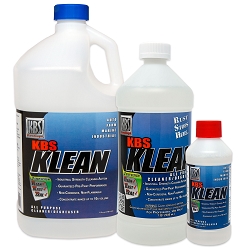
Thorough cleaning is essential for coating adhesion and long-term rust prevention. KBS Klean is a powerful water-based cleaner and degreaser that removes oil, grease, and contaminants without leaving residue.
Directions:
- Mix KBS Klean with hot water:
- For steel: dilute between 1:1 and 1:10 depending on soil level.
- For aluminum and non-ferrous metals: dilute no less than 1:25.
- Scrub with a sponge or bristle brush.
- Rinse and dry thoroughly.
Clean surfaces allow the coating to bond properly, ensuring durable, long-term protection for dock hardware and metal components. Full directions: KBS Klean Application Directions.

How Do You Neutralize Rust and Etch Metal for Coating?
Step 3: Neutralize Rust and Corrosion with RustBlast
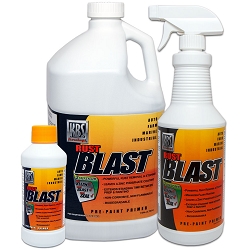
RustBlast is applied to bare metal or areas with light rust or corrosion to neutralize existing oxidation and create an ideal surface profile for RustSeal adhesion.
Directions:
- Spray on and keep the surface wet for 30 minutes to 2 hours, depending on rust or corrosion severity.
- Scrub intermittently with a Scotch-Brite pad.
- Rinse and dry thoroughly.
- A whitish zinc-phosphate residue will remain — this is beneficial and prevents flash rust. Do not remove it.
- RustBlast not only neutralizes active rust and corrosion but also leaves a micro-etched surface profile that promotes superior adhesion for RustSeal. Full directions: RustBlast Application Directions.

How Do You Apply RustSeal for Long-Term Dock Rust Protection?
RustSeal acts as both an oxidation barrier and a foundation for additional coatings or finishes.
Application Guidelines:
- Methods: Brush, roll, or spray. Brushing works best for small dock hardware; spraying delivers the smoothest finish on large dock railings or sections.
- Temperature: Apply between 55°F and 82°F. Avoid high humidity or rainy conditions.
- Mix thoroughly: Stir from the bottom of the can upward before use.
- Coat thickness: Apply at least three thin, even coats with overlapping strokes. Thin coats cure harder and stronger than thick ones.
- Recoat time: Once the previous coat is dry to the touch (2–6 hours), apply additional coats within 8 hours.
- Cure time: Handle after one day; full cure in seven days.
When applied correctly, RustSeal creates a tough, flexible barrier that permanently seals out moisture, oxygen, and salt — eliminating future rust and corrosion on metal dock components. Full instructions: RustSeal Application Directions.

Why Should RustSeal Be Top Coated for UV Protection?
RustSeal provides unmatched corrosion protection but isn't designed for direct, prolonged UV exposure. Over time, sunlight can slightly alter its sheen or color, though its rust-preventive properties remain fully intact. For a UV-stable finish that holds color and gloss, apply a topcoat such as KBS MAXX.
What Makes KBS MAXX Ideal for Dock Applications?
KBS MAXX is a 2K moisture-cured polyurethane topcoat that provides outstanding gloss and color retention, exceptional impact and abrasion resistance, fast-drying characteristics, and superior UV stability. Available in a variety of colors, KBS MAXX delivers the protection and appearance needed for long-lasting, rust-proof dock railings and exposed structures. It can be applied by brush, roller, or spray and forms a rock-hard finish ideal for marine and waterfront environments.

How Should RustSeal Be Prepared Before Applying KBS MAXX?
To ensure strong adhesion between RustSeal and KBS MAXX, use one of these preparation options:
- Apply KBS MAXX once RustSeal's final coat is dry-to-the-touch and no longer leaves a fingerprint (typically 3–6 hours).
- After full curing (24 hours), scuff RustSeal with 320-grit sandpaper, then apply KBS MAXX.
- Alternatively, after full curing, lightly mist with KBS Fusion SEP Self-Etching Primer, allow 30 minutes to dry, then apply KBS MAXX.
How Do You Mix and Apply KBS MAXX?
Mixing Instructions:
- Apply between 50–82°F in moderate humidity. Avoid extreme heat, cold, or wet conditions.
- Thoroughly mix KBS MAXX Base using a mechanical mixer.
- Measure 3 parts KBS MAXX Base to 1 part KBS MAXX Activator into a clean container and mix until uniform.
Application Tips:
- Apply a minimum of three thin, even coats — thin coats provide better adhesion and durability than a few thick ones.
- Avoid puddling and pooling.
- When brushing or rolling, apply and move on immediately rather than overbrushing.
- For brushing and rolling, KBS MAXX Base and Activator are pre-thinned. Additional thinning up to 10% may be done with KBS #1 Thinner or Xylene.
- For rolling, use a high-density foam roller.
- For spraying, thin by 10–15% (up to 30% if needed) with KBS #1 Thinner or Xylene only. Always wear an air-supplied or NIOSH/MSHA-approved organic vapor respirator.
Typical cure times at 77°F / 70% relative humidity:
- Dry to touch: ~30 minutes
- Fully dry: 1–2 hours
- Hard cure: 3–4 hours
- Full cure: 7 days
KBS MAXX is moisture-cured and cures faster in humid environments. Full directions: KBS MAXX Application Directions.
What Are the Long-Term Benefits of Using KBS Coatings on Docks?
Applying KBS Klean, RustBlast, RustSeal, and KBS MAXX provides multiple layers of protection that address every stage of corrosion:
- Surface cleaning eliminates contaminants that interfere with coating adhesion.
- Rust neutralization stops existing oxidation and prepares the surface for sealing.
- Sealing with RustSeal locks out oxygen, moisture, and salt permanently.
- Topcoating with KBS MAXX ensures UV stability and an attractive finish that resists chipping, fading, and cracking.
Conclusion: What's the Best Way to Protect Metal Dock Railings from Rust?
Preventing rust on docks requires more than periodic touch-ups — it demands a comprehensive, science-based process. The KBS Coatings system — KBS Klean, RustBlast, RustSeal, and KBS MAXX — provides a professional-grade, permanent solution for both steel and aluminum dock components. By thoroughly cleaning, neutralizing, sealing, and protecting with the right products, your dock will remain safe, stable, and corrosion-free for decades to come.

Shop the KBS Dock Rust Prevention System
Everything you need to clean, prep, seal, and protect metal dock railings and hardware — made in the USA.
- KBS Klean — Metal cleaner & degreaser
- RustBlast — Rust neutralizer & metal etch
- RustSeal — Permanent rust & corrosion barrier
- KBS MAXX — UV-stable 2K polyurethane topcoat
Tagged Products