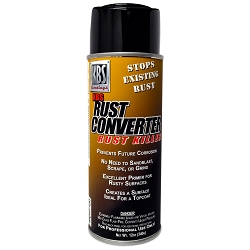


Yes, rust converter paint works on rusted iron and steel. It turns the rust into a stable black layer that stops it spreading and takes paint. KBS Rust Converter is a rust converter paint in a 12 oz aerosol, and it is the fastest of the three KBS methods below because it skips full rust removal.
Updated October 2026 by the KBS Coatings technical team.
Once metal starts to rust, it will not stop on its own. Oxidation keeps eating through the steel until the part fails, so the sooner you act the less metal you lose. KBS Coatings makes three different ways to stop it, built for three different amounts of work.
- Which rust protection method should you use?
- Method 1: rust converter (and why it is also called rust reformer)
- How long does rust converter last?
- Method 2: clean the metal and spray a galvanized coating
- Method 3: remove the rust and seal the metal
- How to remove rust from metal
- Priming after rust removal
- The KBS 3-Step Rust Prevention System
- Using RustSeal and Top Coater Galvanized together
- Side-by-side comparison
- Frequently asked questions
- Which one is right for your project?
Which Rust Protection Method Should You Use?
Pick your method by how much surface prep you are willing to do. Rust converter needs the least: knock off the loose flakes and spray. Top Coater Galvanized needs a wire wheel and a degrease first, then goes on from a can with no gun and no mixing. RustSeal and the KBS 3-Step System need real prep and give you protection that does not need revisiting.
1. Convert the Rust
KBS Rust Converter
- Spray straight onto rusted steel
- No sanding or grinding
- Dries flat black to the touch in 10 minutes
- Paint over it or leave it as-is
- 12 oz. can covers about 20 sq. ft.
Best when access is tight, the area is large, or you need it done today.
Shop Rust Converter2. Clean It and Spray It
KBS Top Coater Galvanized Aerosol
- Wire wheel the loose rust, degrease, spray
- No mixing, no spray gun
- 100% UV stable, will not fade or chalk
- Flat galvanized finish
- 12 oz. can covers up to 30 sq. ft. per coat
Best for fencing, conduit, farm equipment, and anything that should look galvanized.
Shop Galvanized Aerosol3. Strip It and Seal It
RustSeal and the KBS 3-Step System
- Clean, etch, then seal the bare metal
- Non-porous barrier against moisture and oxygen
- Handles heat to 600F, resists fuel and road salt
- Smoothest, best-looking finish
- Longest-lasting protection KBS makes
Best for frames, tanks, restorations, and anything you do not want to touch again.
Shop RustSealMethod 1: Using Rust Converter (Also Called Rust Reformer)
Rust converter is a liquid or aerosol you spray directly onto rusted iron or steel, where an acid reacts with the iron oxide and turns it into a stable, inert compound that no longer spreads. It is the fastest of the three methods because it skips full rust removal entirely. Rust reformer is the same product under a different name.
 Rust converter turns existing rust into a matte black, paint-ready surface without stripping the metal
Rust converter and rust reformer are the same thing. The two terms are used interchangeably across the industry, and there is no meaningful chemical difference between a product sold as one and a product sold as the other. Both react with iron oxide and convert it into a barrier that resists moisture and stops further corrosion.
Most rust converters contain phosphoric acid, tannic acid, or a blend of both:
- Phosphoric acid converts iron oxide into a ferric phosphate layer. It works on exterior metal when top-coated with a quality paint or coating.
- Tannic acid produces a bluish-black ferric tannate layer that can stand alone against exterior weather or serve as a primer for oil-based and epoxy-based paints.
One limitation to know about: rust converter only works on iron and steel. There is no iron oxide on aluminum, copper, stainless steel, or galvanized metal for the acid to react with, so it has nothing to convert.
What KBS Rust Converter Gives You
Before you spray, remove any loose or flaking rust with a stiff bristle brush, wire wheel, or sandpaper so the converter has a stable surface to bond to. That is the whole prep. From there KBS Rust Converter is about as simple as rust work gets:
- No sanding or grinding required
- Dry to the touch in 10 minutes, ready to topcoat in 24 hours
- Converts and primes in one step, so there is no separate primer
- Rated to 250F, which covers exhaust components and engine bays
- Compatible with most topcoats, or leave it as a matte black finish
- One 12 oz. aerosol covers roughly 20 sq. ft.
That combination is why converter earns its place. When the part is large, the access is bad, or the truck has to be back on the road tomorrow, converter is the method that actually gets done.
How Long Does Rust Converter Last?
Rust converter life depends almost entirely on exposure and whether you topcoat it. A converted surface that stays dry or lives indoors holds for years. One that sees road salt, standing water, and constant weather works harder and will eventually want a refresh. Topcoating the converted layer with paint is the single biggest thing you can do to extend it.
Think of converter as a coating you maintain rather than a coating you install once. That is a reasonable trade on a fence line, a piece of farm equipment, or a work trailer, where checking a finish every few seasons is normal anyway. It is a poor trade on a frame you are about to bury under a body, which is exactly the job RustSeal exists for.
KBS Rust Converter
KBS Rust Converter turns a rusty surface into a black, inert, primed surface that is ready for paint. It comes in a 12 oz. aerosol, dries to the touch in 10 minutes, resists heat to 250F, and works under most topcoat systems.
Shop KBS Rust Converter
Method 2: Clean the Metal and Spray a Galvanized Coating
Cold galvanizing is a sprayable coating that leaves a flat, zinc-grey galvanized finish on steel and protects it from corrosion without hot-dip galvanizing. KBS Top Coater Galvanized Aerosol does it from a 12 oz. can that covers up to 30 square feet per coat, dries to the touch in 1 to 2 hours, and fully cures in 24 hours. No mixing, no spray gun, no compressor.
This is the middle path. You do more prep than a rust converter job and far less work than a full RustSeal job, and the finish you end up with is 100% UV stable, so it will not fade or chalk in direct sun the way many zinc aerosols do.
How to Prep Metal for KBS Top Coater Galvanized
Take the surface down to sound metal, then degrease it. Wire wheel, sand, or scrape off every bit of loose, flaking, and scaling rust. Tightly adhered rust that will not come off with a wire wheel is an acceptable substrate. Wash the surface with KBS Klean, rinse, and let it dry completely before you spray.
Avoid solvent-based cleaners here. They leave an invisible residue that interferes with adhesion, which is why KBS Klean is a water-based degreaser. On previously painted or already coated surfaces, scuff with 320 grit paper first, then clean and dry.
When to step up to RustSeal instead: if the metal is still pitted, scaly, or actively flaking after you have wire wheeled it, the rust has gone too deep for a topcoat to fix. Seal it with RustSeal first, then spray Top Coater Galvanized over it as the finish coat. That combination is covered further down.
Where a Galvanized Aerosol Makes the Most Sense
Top Coater Galvanized fits anywhere the part should look galvanized and dragging out a spray gun is not worth it:
- Galvanized touch-ups on fencing, conduit, gutters, and structural steel, where the flat galvanized finish blends into the factory coating instead of patching over it
- Farm and agricultural equipment including implements, livestock panels, grain bins, hay wagons, and outbuilding metal
- Structural steel and ironwork such as I-beams, angle iron, gates, and railings that need corrosion protection without a color topcoat
- Automotive frames and underbody where a factory-galvanized appearance is the goal
- Electrical conduit and junction boxes exposed to weather
- Boat trailers and dock hardware above the waterline. It is not intended for constant immersion, which is RustSeal territory
Spraying It Correctly
Shake the can for a full minute after the mixing ball starts to rattle, then shake it again for 10 seconds every minute or two while you spray. Hold the can 8 to 10 inches off the surface and work in overlapping side-to-side passes. The high-viscosity formula holds on vertical surfaces without running or sagging, so you can lay down a real coat instead of a dusting.
Apply in temperatures between 50 and 90F with humidity at or below 70%. Recoat once the previous coat is dry to the touch, and get all your coats on within 24 hours of each other for the best adhesion between them. Plan on 1 to 2 coats for general work and 2 to 3 coats for marine or industrial exposure. When you are done, invert the can and spray for 3 seconds to clear the nozzle.
KBS Top Coater Galvanized Aerosol
A high-solids cold galvanizing spray in a 12 oz. can. Covers up to 30 sq. ft. per coat, more than twice a conventional aerosol, and stays 100% UV stable so the galvanized finish does not fade or chalk. Use it on its own over cleaned metal, or as the finish coat over RustSeal.
Shop Top Coater Galvanized Read the Application Directions
Method 3: Remove the Rust and Seal the Metal with a Coating
Removing the rust and sealing the bare metal is the longest-lasting rust protection available, and it is what KBS recommends for anything you do not want to revisit. The sequence is remove all rust, prime or etch the bare metal, then apply a barrier coating. Each step matters, and skimping on any one of them shortens the life of the whole system.
 Rust removed and metal sealed with RustSeal, the approach that lasts the longest
RustSeal is a single-component, moisture-cured coating that bonds directly to metal and cures to a rock-hard, ceramic-like film. Because it is non-porous, it locks out the moisture and oxygen that oxidation needs, rather than sacrificing itself to protect the steel. It handles heat to 600F, shrugs off fuel, oils, acids, and road salt, and stays flexible enough that it will not crack, flake, or peel when the metal underneath moves.
How Do You Remove Rust from Metal?
Start by knocking off the loose, flaking rust with a stiff-bristled brush or sandpaper, then pick a removal method based on how bad the corrosion is and how big the part is. Chemical removers work well on parts you can soak or keep wet. Abrasive methods work better on large or heavily corroded surfaces and leave a surface profile that improves paint adhesion.
Chemical and Solvent Rust Removers
White vinegar. Soaking metal in white vinegar for a few hours dissolves rust and leaves a paste you can scrub away. On large objects, apply it directly and scrub once it has had time to work.
Oxalic acid. A white crystalline compound that dissolves in water into a colorless rust-removing solution. Soak time runs from about 20 minutes for light rust to 24 hours for heavy corrosion. Wear gloves, a mask, and safety goggles.
Petroleum-based solvents. Products like WD-40 are less corrosive than acids and work on moderate rust, though full results can take up to 24 hours.
Water-based rust removers. Acid-free formulas use chelation to pull rust molecules away from the metal into a substrate. Light rust dissolves in about 30 minutes and heavy rust may need an overnight soak. RustBlast is KBS Coatings' water-based option, and it etches the metal and leaves a zinc phosphate base coat while it works.
Abrasive Rust Removal
Mechanical abrasion is one of the most effective methods available. Hand sanding, angle grinders, orbital sanders, and drill-mounted wire wheels or surface-finishing discs all work. Sandblasting is the most thorough of the group: it removes rust completely and leaves a textured profile that dramatically improves how well a coating grips.
Priming After Rust Removal
Bare metal needs to be primed or etched before a topcoat goes on, especially anywhere it will see moisture. Priming gives the coating something to anchor to, and on freshly stripped steel it also protects the surface during the window between prep and paint. There are two common options, and they behave differently.
Self-etching primer. Uses acid to micro-etch the metal and create an anchor pattern for the primer and topcoat. Many self-etching primers also deposit zinc phosphate for extra protection. KBS Fusion SEP is ready for a topcoat in about an hour, which keeps project times short.
Epoxy primer. Adheres very well but does not etch on its own, so the surface has to be sanded to 80 to 180 grit or sandblasted first to create the profile. Epoxy primers also take longer to cure than self-etching options.
Recoating over epoxy: cured epoxy does not accept new paint without preparation. Sand it with 120 to 220 grit before recoating so the new film has something to bond to.
The KBS 3-Step Rust Prevention System
The KBS 3-Step System is three products used in order that handle cleaning, rust removal, and sealing in one process. Use KBS Klean to strip contaminants, RustBlast to dissolve the rust and etch the metal, then RustSeal to seal it. Each step sets up the next, which is why the system outperforms any of the three used on its own.
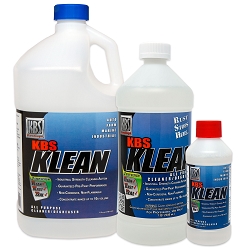
- KBS Klean. A concentrated, water-based, biodegradable cleaner that removes dirt, oil, grease, and road film. Apply, scrub with a brush or scouring pad, and rinse. Skipping this step is the most common reason a coating fails, because oil residue blocks adhesion no matter what goes on top of it.
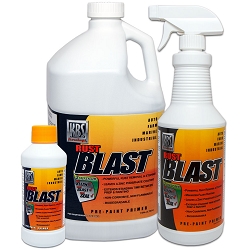
- RustBlast. A water-based, biodegradable solution that dissolves and neutralizes rust while etching the metal and leaving a zinc phosphate base coat. Keep the surface wet for 30 minutes on smooth metal, 40 to 60 minutes on moderate rust, or 1 to 2 hours on heavy rust, then rinse with water.
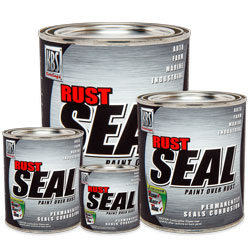
- RustSeal. A single-part, moisture-cured coating that seals metal away from moisture and oxygen. Apply a minimum of two thin coats by brush, roller, or spray gun, and three coats on anything consistently exposed to water. A quart covers about 50 sq. ft. at two coats.
Stuck or unsure? Search the KBS Support Desk for instant answers
Try the KBS 3-Step System
The System Sampler Kit puts all three products in one package, enough to treat up to 12 sq. ft. It is the cheapest way to run the full KBS process on a small part before you commit to full-size quantities. Doing a whole frame? The Frame Coater Kit covers about 50 sq. ft.
Shop the System Sampler Kit Learn More About the System
Using RustSeal and Top Coater Galvanized Together
RustSeal is not designed to be a final finish in sunlight, so on anything exposed to daylight it needs an opaque topcoat, and KBS Top Coater Galvanized is one of the easiest to apply. RustSeal's rust protection does not degrade under UV, but prolonged direct sun will change its color and sheen. A topcoat prevents that. A clear coat cannot, because clear does not block UV from reaching the film underneath.
The two products are built to work together. Spray Top Coater Galvanized over RustSeal while the RustSeal is between 3 and 8 hours old and no additional prep is required at all. Miss that window and you scuff with 320 grit, clean, dry, and then spray.
- KBS Klean to remove grease, oil, wax, and road film
- RustBlast to dissolve the rust and etch the metal
- RustSeal in two coats to seal the metal permanently
- Top Coater Galvanized over the cured RustSeal for a UV-stable galvanized finish
If a galvanized look is not what you want, RustSeal itself comes in 11 colors, and KBS Top Coater Aerosol is available in a full range of colors using the same high-solids, UV-stable, no-run formula.
Rust Converter vs. Galvanized Aerosol vs. Rust Removal: Side by Side
| Feature | KBS Rust Converter | Top Coater Galvanized | RustSeal & 3-Step System |
|---|---|---|---|
| How it works | Chemically converts iron oxide to an inert layer | Seals cleaned metal under a UV-stable galvanized film | Removes rust, then bonds a non-porous barrier to the metal |
| Prep required | Knock off loose rust | Wire wheel to sound metal, degrease with KBS Klean | Clean, dissolve rust, etch |
| Application | 12 oz. aerosol | 12 oz. aerosol, no gun or mixing | Brush, roller, or spray gun |
| Coverage | About 20 sq. ft. per can | Up to 30 sq. ft. per can, per coat | About 50 sq. ft. per quart at two coats |
| Dry and cure | Touch dry in 10 min, topcoat in 24 hr | Touch dry in 1 to 2 hr, cure in 24 hr | Moisture cured, two coats minimum |
| Finish | Flat black, follows the rust texture | Flat galvanized, blends with factory galvanizing | Smooth and hard, 11 colors |
| UV stability | Topcoat for exterior color hold | 100% UV stable, no fade or chalk | Protection holds, but topcoat it for color hold |
| Heat resistance | Up to 250F | Standard exterior service | Up to 600F |
| Works on | Iron and steel only | Steel, iron, and galvanized | Bare metal, treated rust, galvanized, concrete |
| Best for | Speed, tight access, large rusted areas | Fencing, farm equipment, conduit, galvanized touch-ups | Frames, tanks, restorations, permanent protection |
So Which Method Is Right for Your Project?
Match the method to the job rather than to a ranking. Rust converter is right when the clock or the access is the constraint. Top Coater Galvanized is right when you want a durable, good-looking finish out of a can. RustSeal and the 3-Step System are right when the part matters enough to do properly, and they deliver the longest protection KBS makes.
- Speed is the main concern
- The area is large or hard to reach
- Full rust removal is not practical
- A matte black finish is fine, or you plan to paint over it
- You want a UV-stable finish that will not fade
- The part should look galvanized
- You would rather not set up a spray gun
- The metal cleans up to sound steel with a wire wheel
- You want the longest-lasting protection available
- A smooth, high-quality finish matters
- The part sees fuel, chemicals, salt, or heat
- You do not want to redo this job
Ready to stop the rust?
Start with the System Sampler Kit if you want to try the full KBS process on a small part, or go straight to the product that fits your job.
Shop the System Sampler Kit Shop RustSeal Shop Top Coater Galvanized Shop Rust Converter
Frequently Asked Questions About Stopping Rust
What is the best rust remover for cars?
The best rust remover for a car depends on the part. A water-based remover such as RustBlast works best on parts you can soak or keep wet, and it etches the steel and leaves a zinc phosphate layer, so the metal is ready for RustSeal. Sandblasting or a wire wheel is faster on large or heavily scaled areas such as frames.
What is the difference between rust converter and rust reformer?
There is no meaningful difference. Rust converter and rust reformer are two names for the same category of product. Both use phosphoric acid, tannic acid, or a blend to chemically convert iron oxide into a stable, inert layer. Manufacturers use the terms interchangeably.
How does rust converter work?
Rust converter contains an acid that reacts with iron oxide. Phosphoric acid converts rust into ferric phosphate, and tannic acid converts it into a bluish-black ferric tannate. Either way the rust is chemically changed into a stable compound that no longer spreads, and the converted layer acts as a primer for topcoats. KBS Rust Converter dries to the touch as a flat black finish in 10 minutes and is ready to topcoat in 24 hours.
How long does rust converter last?
It depends almost entirely on exposure and whether you topcoat it. A converted surface that stays dry or indoors holds up far longer than one that sees road salt, standing water, and constant weather. Topcoating the converted layer with paint is the single biggest thing you can do to extend it. KBS Rust Converter is topcoat compatible with most paint systems and can also be left as a matte black finish.
Can I spray KBS Top Coater Galvanized over rust?
Yes, over sound rust. Wire wheel or sand off every bit of loose, flaking, and scaling rust, degrease the surface with KBS Klean, and let it dry completely. Tightly adhered rust that will not come off with a wire wheel is an acceptable substrate. For heavy, pitted, or actively flaking corrosion, coat the metal with RustSeal first and use Top Coater Galvanized as the finish coat.
Can rust converter be used on aluminum, stainless steel, or galvanized metal?
No. Rust converter works only on iron and steel. It will not react on aluminum, copper, stainless steel, or galvanized metal surfaces, because there is no iron oxide for the acid to convert.
Does RustSeal need a topcoat?
Only where sunlight reaches it. RustSeal's rust protection does not degrade in UV, but prolonged direct sun will change its color and sheen. On a frame rail, a floor pan, or the underside of a vehicle, RustSeal is the final finish. On anything exposed to daylight, topcoat it with an opaque paint such as KBS Top Coater Galvanized. A clear coat cannot provide the needed UV protection.
How much area does one can of KBS Top Coater Galvanized cover?
A 12 oz. can of KBS Top Coater Galvanized Aerosol covers up to 30 square feet in one coat, which is more than twice the coverage of a conventional aerosol spray paint. Plan on 1 to 2 coats for general use and 2 to 3 coats for marine or industrial exposure. Apply all coats within 24 hours of each other.
Which KBS product stops rust the longest?
RustSeal. It is a moisture-cured, high-solids coating that bonds to metal and forms a non-porous barrier against the moisture and oxygen rust needs to grow. Applied over a properly cleaned and etched surface as part of the KBS 3-Step System, RustSeal is the longest-lasting rust protection KBS makes and does not need reapplication.
What products does KBS Coatings offer for rust prevention?
Three routes. KBS Rust Converter is a 12 oz. aerosol that chemically converts rust in place. KBS Top Coater Galvanized Aerosol is a UV-stable cold galvanizing spray for cleaned metal. The KBS 3-Step System pairs KBS Klean and RustBlast with RustSeal for permanent protection. A System Sampler Kit is available for small projects up to 12 sq. ft.
Still have questions? Search the KBS Support Desk for instant answers
Tagged Products