

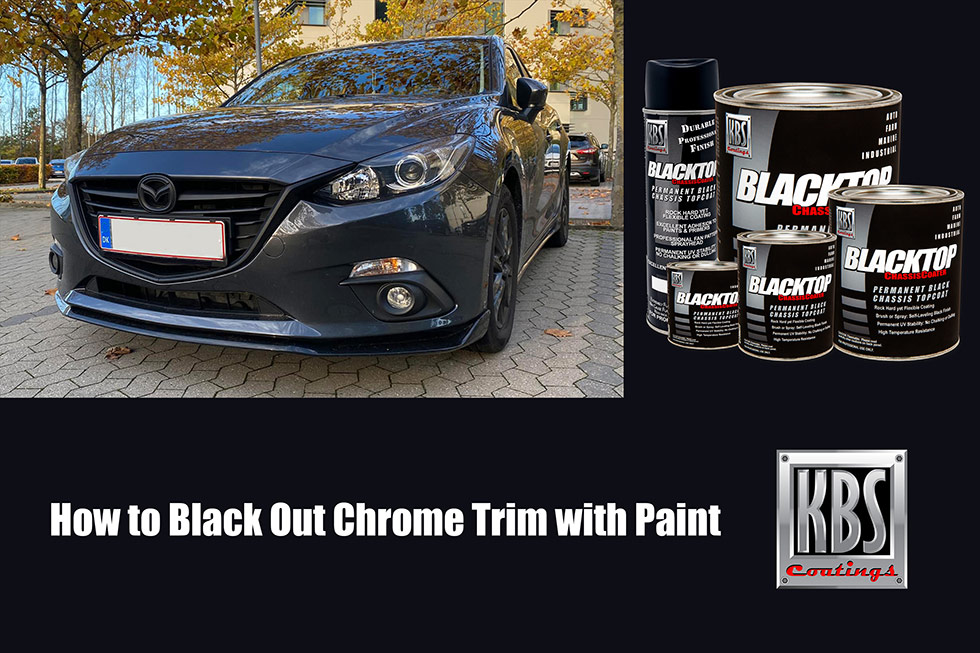
You black out chrome trim with paint in three steps: scrub the chrome with KBS Klean, lay down one light dust coat of Fusion Self-Etching Primer, then spray BlackTop in OEM Satin Black in light coats. BlackTop is a single stage, moisture cured 1K urethane, so the trim finishes black in one product with no separate clear coat, and it is fully cured in 48 hours.
That is the short version of a chrome delete done in paint instead of vinyl. The rest of this guide covers why chrome fights paint in the first place, which sheen matches your factory trim, what the job actually costs, and the prep sequence that decides whether the finish lasts a season or a decade.
- Best Paint for Chrome Trim and Why BlackTop Holds
- Chrome Delete in Paint vs Vinyl Wrap and Plasti Dip
- Why Black Out Chrome Trim
- What Trim Pieces Can You Black Out
- What You Need and What It Costs
- How to Prepare Chrome Trim for Paint
- How to Paint Chrome Trim Black
- Frequently Asked Questions
- A Chrome Delete That Stays Black
Best Paint for Chrome Trim and Why BlackTop Holds
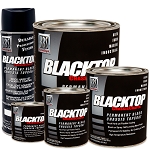
BlackTop in OEM Satin Black is the paint to use on chrome trim. It is a single stage, moisture cured 1K urethane that carries permanent UV stability, so it does not chalk or fade and it needs no clear coat over the top. It reaches 5H pencil hardness at 96 hours, absorbs 160 inch-pounds of direct and indirect impact, and passes 1,000 hours of B117 salt spray on its own at 4 to 5 mils.
Those last two numbers matter more on trim than they do anywhere else on a vehicle. Window surrounds, grilles, and door handles take stones, fingernails, ice scrapers, and door edges. A coating that is only hard will chip at the edges, and a coating that is only flexible will scuff. BlackTop is both, which is why it survives on chassis and frames and why it survives on trim.
It also self-levels. BlackTop can be brushed, rolled, or sprayed, and when brushed it flows out rather than holding brush marks, as long as you lay it on and move along instead of working the same area over and over. Most people spraying trim reach for the aerosol anyway, which is the version this guide assumes.
Which BlackTop Sheen Matches Factory Trim
OEM Satin Black is the factory match on most vehicles. BlackTop comes in three measured sheens, and the numbers are the fastest way to pick:
- Gloss Black, 85 to 95 percent gloss. A wet, reflective show finish. Use it when you want the trim to read as glass-black against body paint.
- OEM Satin Black, 55 to 65 percent gloss. The semi-gloss look most factory chassis, suspension, and trim parts left the plant wearing. This is the safe choice for a chrome delete that should look like it came that way.
- Flat Black, 15 to 20 percent gloss. Non-reflective, and the best at hiding surface imperfections in older pitted trim.
All three share the same resin and the same durability data, so sheen is purely an appearance decision. Sizes run from aerosol up to 5 gallon, and a single aerosol covers roughly 38 square feet.
Chrome Delete in Paint vs Vinyl Wrap and Plasti Dip
Paint is the permanent option and vinyl is the reversible one, and that is the whole trade. A wrap or a peelable coating can come back off, which is exactly what you want on a leased vehicle and exactly what you do not want on a truck you plan to keep. Vinyl also has edges, and edges on window trim are where lifting, dirt lines, and peeling start after a couple of seasons of car washes and sun.
Painted trim has no edges to lift because the coating is bonded to the metal. Complex shapes are the other place the two methods separate: a grille, a badge, or a curved mirror cap that takes a wrap installer an hour of heat gun work is a two-minute spray job. Where vinyl still wins is a flat window surround on a lease, and a total reversal later.
Why Black Out Chrome Trim
Two reasons, and most people have both. Blacked out trim gives a car or truck a custom, aggressive look, and the contrast against body color can be dramatic in a way that bright chrome is not. It is also the cheapest way to fix trim that has stopped looking good.
Chrome does not age gracefully. It scratches. Airborne pollutants and road debris build up and discolor it. Corrosion pits it, and oxidation dulls the shine unevenly, which is worse to look at than a uniform dull finish would be. Paint hides every one of those, and Flat Black hides the most.
What Trim Pieces Can You Black Out
Anything chrome you can clean, mask, and reach with a spray can. On a typical car or truck that means:
- Chrome window trim and window surrounds
- Chrome grilles and grille surrounds
- Chrome emblems and badges
- Chrome door handles and mirror caps
- Chrome bumpers and trim accents
- Chrome interior trim
- Motorcycle chrome
Parts you can unbolt, badges and door handles especially, come out better than parts you mask in place, because you can coat the edges and the back side where a masked part gets a visible line. Exhaust tips are the one common exception. BlackTop is rated to 500F, and an exhaust tip can run past that, so tips belong in XTC, the 1200F header and exhaust paint, rather than BlackTop.
What You Need and What It Costs
A do-it-yourself chrome delete costs about 68 dollars in materials at current KBS pricing, which is less than most single-panel wrap kits. Three products do the whole job:
| KBS Klean, quart | Removes grease, wax, and road film with no residue left behind | 14 dollars |
| Fusion SEP, aerosol | Etches and bonds to chrome, ready to topcoat in about an hour | 27 dollars |
| BlackTop, aerosol, OEM Satin Black | The finish coat, roughly 38 square feet per can | 27 dollars |
Add masking tape, masking paper, a scrub brush, and lint-free cloths from the garage shelf. One aerosol of each is enough for the window trim, grille, and badges on a typical car.
How to Prepare Chrome Trim for Paint
Prep is the entire job on chrome. Chrome is harder and smoother than any surface paint normally lands on, which is why coatings that grip bare steel without complaint will sheet straight off chrome in a season. The fix is two products: a cleaner that leaves nothing behind, and a self-etching primer that gives the topcoat something to key into.
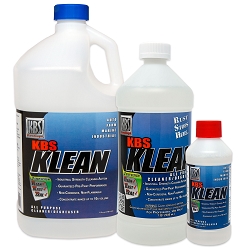
KBS Klean
KBS Klean is a concentrated, water-based, biodegradable cleaner and degreaser that removes grease, oil, grime, and road film without leaving a residue. The no-residue part is why it is step one here rather than a solvent wipe. Solvent-based cleaners leave an invisible film that BlackTop will not bond through, which is a failure you do not see until the coating lifts months later.
KBS Klean is a concentrate, so dilute it with warm water before use. Warmer water cleans better. Read the full KBS Klean directions for the dilution ratio that fits your surface.
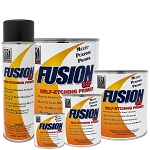
Fusion SEP
Fusion SEP is a fast-drying, all-purpose self-etching primer that bonds directly to bare steel, aluminum, galvanized metal, copper, bronze, chrome, fiberglass, GRP, SMC, polyester filler, and most hard plastics. Chrome is on that list by name, and Fusion SEP is ready for a topcoat in about one hour.
It goes on as a dust coat here, not a build coat. Fusion SEP is doing one job on chrome: turning a surface paint slides off of into a surface paint holds. A heavy coat does not improve adhesion and only adds film that can chip.
Surface Preparation Steps
- Scrub the chrome trim with diluted KBS Klean to remove dirt, grease, wax, and road film. Rinse with clean water and dry thoroughly. View the KBS Klean directions.
- Mask off body paint, glass, and rubber weatherstripping with masking tape and paper.
- Apply one light dust coat of Fusion SEP to the chrome and let it dry completely. View the Fusion SEP directions.


How to Paint Chrome Trim Black
Spray BlackTop in light coats rather than one heavy pass, and recoat as soon as the previous coat is dry to the touch and no longer leaves a fingerprint. Work in moderate to dry conditions, 60 to 78F and 70 percent relative humidity or lower. Full cure is 48 hours.
- Shake the BlackTop aerosol for at least one minute after you hear the mixing ball rattle, then shake it again for about 10 seconds every minute or two while you work.
- Hold the can 6 to 8 inches from the surface. Do not cover with a continuous spray. Move back and forth, releasing the spray head at the end of each stroke, and overlap each stroke.
- Recoat once the previous coat is dry to the touch and does not leave a fingerprint, and always inside 24 hours. Past 24 hours, lightly scuff the cured coat with 320 grit paper or a green Scotch-Brite pad first.
- When you are done, invert the can and spray for 4 seconds to clear the valve. A clogged button cleans with KBS #1 Thinner, never a pin or a wire.
- BlackTop can also go on by HVLP, brush, or a small foam roller if you are coating something larger than trim. Read the full BlackTop application directions.
Wear protective gloves and eyewear, and use a NIOSH or MSHA approved air-supplied respirator. BlackTop cleans up with KBS #1 Thinner before it dries and cannot be removed by any solvent once it has cured, which applies to skin as well as to overspray.
Stuck or unsure? Search the KBS Support Desk for instant answers

Frequently Asked Questions About Blacking Out Chrome Trim
How to turn chrome trim to black?
Turn chrome trim black in three steps. Scrub the trim with KBS Klean and rinse it, apply one light dust coat of Fusion Self-Etching Primer and let it dry, then spray BlackTop in OEM Satin Black in light coats. Recoat each time the previous coat is dry to the touch. BlackTop is fully cured in 48 hours.
How much does it cost to black out chrome trim?
A do-it-yourself chrome delete with KBS products runs about 68 dollars in materials at current KBS pricing: a quart of KBS Klean at 14 dollars, a Fusion SEP aerosol at 27 dollars, and a BlackTop aerosol at 27 dollars. One BlackTop aerosol covers roughly 38 square feet, which is more than enough for the window trim, grille, and badges on a typical car.
How can I black out chrome?
The same clean, etch, and coat sequence works on any chrome you can reach with a spray can: window trim, grilles, badges, door handles, bumpers, mirror caps, and motorcycle chrome. Parts you can unbolt come out cleaner because you can coat every edge. BlackTop is rated to 500F, so anything that runs hotter than that, exhaust tips included, belongs in a high temperature coating instead.
What is the best paint to use to blackout chrome trim?
BlackTop in OEM Satin Black is the sheen that matches the factory look on most vehicles, because OEM Satin measures 55 to 65 percent gloss. Gloss Black measures 85 to 95 percent for a wet show finish and Flat Black measures 15 to 20 percent for a non-reflective look. All three use the same resin and carry the same durability data.
Do you have to sand chrome before painting it?
No sanding is required with this method. Chrome is too hard and too smooth for paint to grip on its own, so the light dust coat of Fusion Self-Etching Primer does the work sandpaper would otherwise do. Fusion SEP bonds directly to chrome and is ready for a topcoat in about one hour.
How long does BlackTop take to dry and cure on chrome trim?
Recoat BlackTop as soon as the previous coat is dry to the touch and no longer leaves a fingerprint, and always inside 24 hours. Full cure is 48 hours. If more than 24 hours pass between coats, scuff the cured coat with 320 grit paper or a green Scotch-Brite pad before adding another.
Still have questions? Search the KBS Support Desk for instant answers
A Chrome Delete That Stays Black
Blacking out chrome trim is a weekend job with an afternoon of actual work in it, and the part that decides how it looks in five years happens before any black paint comes out of the can. Clean it so nothing is left on the surface, etch it so the topcoat has something to hold, then let BlackTop do what it does on frames and chassis. No clear coat, no edges to lift, no annual redo.
Have questions about blacking out chrome trim on your vehicle? Contact us here and we are happy to help.
Tagged Products