

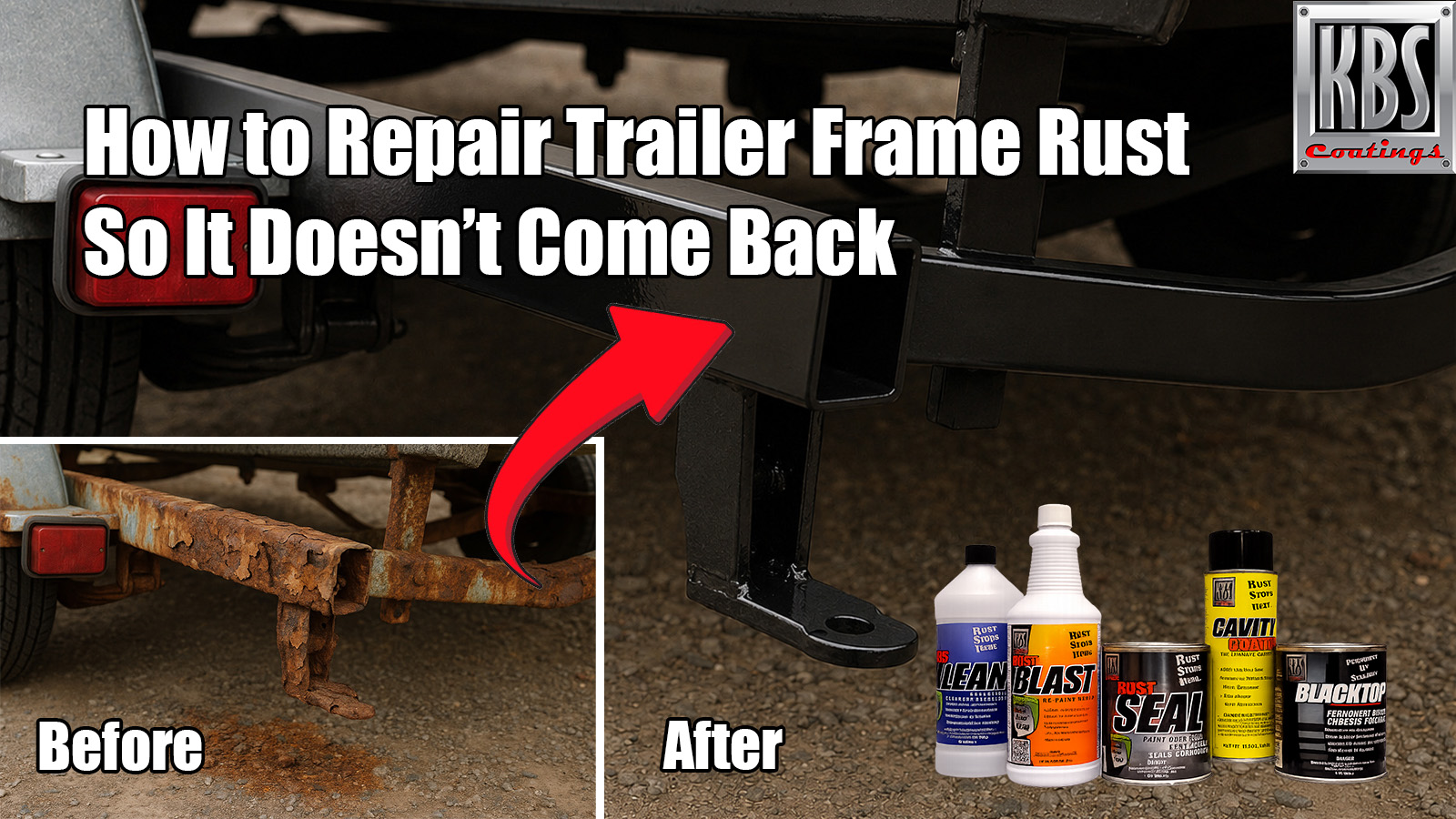
To remove rust from a trailer frame and keep it from coming back, strip loose rust, degrease with KBS Klean, etch with RustBlast, then seal with at least two coats of RustSeal and spray Cavity Coater inside the tubing.
Updated October 2026 by the KBS Coatings technical team.
What You Need
Get the complete kit, or buy each product on its own. Orders placed by 3 PM Central ship the same day.
- Why Trailer Frame Rust Keeps Coming Back
- Surface Rust vs Structural Rust on a Trailer Frame
- What Is the Best Way to Repair Trailer Frame Rust?
- What You Need to Repair a Rusted Trailer Frame
- How to Properly Prep a Rusty Trailer Frame Before Painting
- Best Way to Coat a Trailer Frame to Prevent Rust
- How to Apply RustSeal to a Trailer Frame
- Apply a Top Coat
- How to Coat the Inside of a Trailer Frame to Stop Rust
- Frequently Asked Questions About Trailer Frame Rust
- How to Repair Trailer Frame Rust the Right Way
| Products | KBS Klean, KBS RustBlast, KBS RustSeal, BlackTop (sun-exposed frames), Cavity Coater (inside the tubing) |
|---|---|
| RustBlast dwell time | 30 minutes on smooth or light rust, 40 to 60 minutes on moderate rust, 1 to 2 hours on heavy rust |
| RustSeal and BlackTop application temperature | 55 to 82°F, in moderate to dry conditions |
| RustSeal coats | Minimum 2 thin coats at about 2 mils each; minimum 3 for marine or industrial use |
| RustSeal recoat window | Once dry to the touch (2 to 6 hours); if more than 8 hours pass, wait 24 hours and scuff |
| RustSeal full cure | 24 hours after the final coat |
| BlackTop full cure | 48 hours |
| RustSeal coverage | 200 square feet per gallon at two coats |
Why Trailer Frame Rust Keeps Coming Back
Trailer frame rust comes back when moisture, oxygen and road salt keep reaching the steel under the paint. The usual causes are rust that was never fully removed, rust that was covered instead of treated, and a coating that failed and let water in. Sealing the metal completely is what stops the cycle.
Surface Rust vs Structural Rust on a Trailer Frame
Surface rust and pitting can be cleaned, treated and sealed, but rust that has eaten through the steel needs a structural repair first. Inspect the whole frame before you buy anything. Look for:
- Perforation or rust-through holes in the steel
- Thinning metal
- Cracked welds around structural areas
- Damaged crossmembers or spring hanger sections
- Heavy scaling or flaking rust
- Anything that affects towing stability or load support
Do structural repairs before rust treatment and recoating. A coating seals rust. It does not put strength back into a weakened frame.
What Is the Best Way to Repair Trailer Frame Rust?
The best way to repair trailer frame rust is a full process, not a coat of paint over corroded metal. Each stage prepares the steel for the next one:
- Clean off dirt, grease and contaminants.
- Remove loose rust and failing coatings.
- Treat the metal so the coating bonds.
- Seal the frame, tubing included, inside and out, with a rust preventive coating.
- Add a protective top coat made for outdoor exposure.
What You Need to Repair a Rusted Trailer Frame
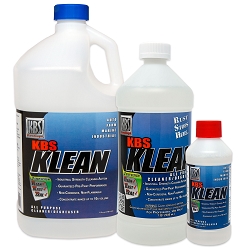
- KBS Klean: water-based cleaner and degreaser that removes oil and grime
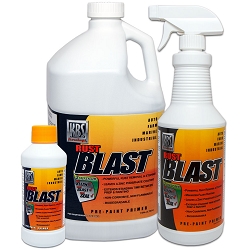
- KBS RustBlast: rust remover and zinc phosphate surface prep
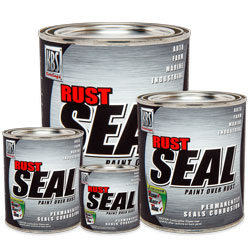
- KBS RustSeal: the moisture-cured coating that stops and prevents rust
- BlackTop (for frames in sun): UV-stable top coat over RustSeal
- Cavity Coater with a Cavity Wand: protective film for the inside of the tubing
- KBS #1 Thinner: for thinning RustSeal and BlackTop when needed, and for clean up
- KBS Paint Mixing Cup: to paint out of, not to store leftover RustSeal in
- Chemical-resistant gloves, safety glasses and an air-supplied respirator when spraying
- Wire wheel, 320-grit sandpaper or a sandblaster, Scotch-Brite pads, a sponge, a scrub brush and paint brushes or spray equipment
How to Properly Prep a Rusty Trailer Frame Before Painting
Prep decides whether the repair lasts: clean the frame, remove loose rust and treat the steel with RustBlast before any coating goes on. Follow the three steps below, in order.
Step 1: Remove Loose Rust, Paint and Coating
Remove all loose rust, paint and failing coating first, because RustSeal needs a solid surface to bond to. Use one of these:
- Wire wheel
- 320-grit sandpaper
- Sandblasting
Where old coating is still firmly bonded, scuff it with 320-grit sandpaper so RustSeal has something to grip. Light surface rust can stay when it is treated with RustBlast and coated with RustSeal. Freshly sandblasted metal that has only been handled with gloved hands can take RustSeal directly after you blow off the loose dust.
Step 2: Clean and Degrease Thoroughly
Clean the whole frame with KBS Klean after the rust and old paint are off. It lifts dirt, grease and grime and leaves no residue that blocks adhesion. Mix it with hot water, 5 parts water to 1 part KBS Klean works for general cleaning, and scrub with a sponge or bristle brush.
- Rinse with water and let the frame dry completely.
- See the full KBS Klean application directions.

Step 3: Treat Metal and Neutralize Remaining Rust
Treat the frame with RustBlast before RustSeal to neutralize existing rust and leave a micro-etched surface that RustSeal grips. Spray it on bare metal or lightly rusted areas, and keep the surface wet for the full dwell time:
- 30 minutes on smooth or lightly rusted steel
- 40 to 60 minutes on moderately rusted steel
- 1 to 2 hours on heavily rusted or corroded steel
Scrub intermittently with a Scotch-Brite pad and never let RustBlast dry on the surface. Rinse it off with water while it is still wet, then let the frame dry completely. The rinse neutralizes the acid and prevents heavy zinc phosphate buildup. A thin white zinc phosphate film will stay behind. That film is expected and helps RustSeal adhere, so do not scrub it off. See the full RustBlast application directions.

KBS Coatings 3-Step Rust Prevention System
Everything you need to clean, treat and seal a trailer frame against rust:
RustSeal
Rust preventive coating that seals the frame
RustBlast
Rust remover and metal prep
KBS Klean
Cleaner and degreaser
Best Way to Coat a Trailer Frame to Prevent Rust
The best way to coat a trailer frame is a coating system that seals the metal from moisture, oxygen and corrosive contaminants, applied over a properly prepped surface. Adhesion matters most, because coatings that fail on trailers usually fail from poor adhesion or moisture getting under them.
What Makes a Trailer Frame Coating Last
A trailer frame coating lasts when it bonds to the steel and keeps its barrier under real-world abuse. Look for a coating that:
- Stops and prevents rust
- Bonds strongly and seals the metal from moisture, oxygen and contaminants
- Seals porous or lightly rusted metal
- Resists impacts, chips and abrasion
- Flexes without cracking, peeling, flaking or delaminating
- Resists road salt, chemicals, dirt, mud and road debris
Best Rust Prevention Paint for Rusty Trailer Frames
KBS RustSeal is the rust preventive coating in the KBS system, and it is built for metal that needs heavy protection. It is a 1K moisture-cured urethane that forms a permanent barrier between the steel and moisture, chemicals and other corrosive contaminants. It is hard but flexible, so it resists impacts and abrasion instead of chipping and peeling.
RustSeal self-levels to a smooth finish that hides brush marks, and you can apply it to rusted, treated or bare metal. It comes in 11 colors. Because light surface rust can stay under it, RustSeal cuts prep labor. Deep pitting, rust inside weld seams and spots where you cannot get all the rust out can be sealed and encapsulated so the corrosion stops progressing.
How to Apply RustSeal to a Trailer Frame
Apply RustSeal between 55 and 82°F in at least two thin, overlapping coats of about 2 mils each, recoating once the last coat is dry to the touch. It is fully cured 24 hours after the final coat. Here is the full method:

- Method: brush, roll or spray.
- Temperature: 55 to 82°F, and not in rain or high humidity.
- Mix: stir thoroughly from the bottom of the can to the top before use. Pour a working amount into a KBS Paint Mixing Cup or a steel or glass container instead of painting out of the can, and do not store leftover RustSeal in the plastic cup.
- Thinning: spraying does not usually need thinning. If it does, 5 to 10% with KBS #1 Thinner or xylene is normally enough. Never use lacquer thinner.
- Coats: apply two thin, even coats at a minimum. Use at least three on boat trailers and other marine or industrial work. Several thin coats beat a few thick ones.
- Recoat: add the next coat once the previous one is dry to the touch, typically 2 to 6 hours. If more than 8 hours pass, wait 24 hours and lightly scuff with 320-grit sandpaper or a green Scotch-Brite pad.
- Over rust: RustSeal goes over light surface rust that has been treated with RustBlast.
- Cure: RustSeal is fully cured 24 hours after the final coat. Wait that long before reassembly or putting the trailer back in service.
When spraying, wear an air-supplied respirator. See the full RustSeal application directions.
Apply a Top Coat
Top coat RustSeal with an opaque, UV-stable coating like BlackTop wherever the frame sits in direct sun. RustSeal's rust protection does not break down in sunlight, but its color and sheen fade. A clear coat does not fix that. A frame kept out of the sun can stay RustSeal.
How to Prepare RustSeal for Top Coating
Pick one of these three ways to get BlackTop to bond to RustSeal:
- 3 to 8 hour window: top coat once the last RustSeal coat is dry to the touch and between 3 and 8 hours old. No other prep is needed.
- Scuff method: let the final coat cure at least 24 hours, then scuff it with 320-grit sandpaper.
- Self-etching primer method: after 24 hours of cure, apply a dust coat of Fusion SEP self-etching primer, let it cure 30 minutes, then top coat.

Apply BlackTop
Apply BlackTop in one or two thin coats at 55 to 82°F, recoating before 24 hours, and allow 48 hours for full cure. Follow these points:
- Method: brush or spray.
- Temperature and humidity: 55 to 82°F, at 70% humidity or lower, and not in rain.
- Mix: stir from the bottom of the can to the top. Do not shake it.
- Thinning: usually not needed. If it is, 5 to 10% with KBS #1 Thinner or xylene is normally enough, and in heat or humidity that thinning slows the cure so brush marks level out. Never use lacquer thinner.
- Coats: apply thin, even coats. Use two on boat trailers and other marine or industrial work.
- Recoat: once the previous coat is dry to the touch and before 24 hours. After 24 hours, scuff with 320-grit sandpaper or a Scotch-Brite pad first.
- Cure: full cure is 48 hours, depending on temperature and film thickness.

See the full BlackTop application directions.
How to Coat the Inside of a Trailer Frame to Stop Rust
Coat the inside of boxed trailer frame tubing with Cavity Coater sprayed through a Cavity Wand, after the exterior coatings have fully cured. Rust inside boxed tubing is a major cause of trailer frame failure, because moisture, salt and debris sit there where you cannot see them. Use Cavity Coater for the inside of the rails rather than thinned RustSeal.
- Remove any readily accessible loose, scaly rust.
- If grease or oil is present, clean the surface with KBS Klean as described in Step 2.
- Work at 70 to 80°F on a dry surface.
- Attach the Cavity Wand to the Cavity Coater aerosol. The wand goes through a 1/4 inch hole. If a tube has no drain hole, drill one at the lowest accessible point.
- Shake the can extremely well, insert the wand, depress the spray tip and withdraw it at about 2 inches per second. Repeat for complete coverage.
- Apply a thin, even coat of about 1 mil. Wait 10 minutes for it to wick into seams and weld joints, then wipe off excess with a rag lightly dampened with mineral spirits.
- Flush the wand by inverting the can and spraying for 10 seconds.
Do not paint or caulk over Cavity Coater. RustSeal will not stick to it, which is why it goes on last. See the Cavity Coater application directions for complete instructions.

Stuck or unsure? Search the KBS Support Desk for instant answers
Frequently Asked Questions About Trailer Frame Rust
What are the steps to repaint an old trailer?
Strip loose rust and failing paint with a wire wheel, 320-grit sandpaper or a sandblaster, degrease with KBS Klean, etch the metal with RustBlast and rinse, then brush, roll or spray at least two thin coats of KBS RustSeal. Add BlackTop where the trailer sits in sun, and spray Cavity Coater inside the frame tubing last.
Is it worth fixing a rusted frame?
Yes, when the steel is still sound. Surface rust, scale and pitting can be cleaned, treated and sealed with KBS RustSeal. If the frame has rust-through holes, thinning metal or cracked welds, repair the structure first, because a coating seals rust but does not restore strength.
How can I remove rust from my boat trailer?
Wire wheel or sand off loose rust, degrease with KBS Klean, then keep KBS RustBlast wet on the steel for 30 minutes to 2 hours depending on how rusty it is. Rinse and let it dry. Seal with at least three thin coats of KBS RustSeal, which is used on boat trailers, and spray Cavity Coater inside boxed frame tubing.
What is the best way to remove rust from a truck frame?
Remove loose scale, degrease with KBS Klean, treat the frame with KBS RustBlast, then seal it with KBS RustSeal. The same three-step system works on truck and trailer frames, and Cavity Coater protects the inside of the rails.
Why does trailer frame rust keep coming back after painting?
Trailer frame rust returns when rust was not fully removed, properly treated, or completely sealed from moisture, oxygen and road contaminants before recoating. Incomplete prep and failing coatings let corrosion keep working underneath the paint.
What is the best coating for a rusty trailer frame?
A rust preventive coating like KBS RustSeal that seals metal from moisture, oxygen, road salt and chemicals. It should also resist impacts, abrasion and peeling, and it should bond to lightly rusted steel.
Can RustSeal be applied directly over rust?
Yes, over tight surface rust that has been cleaned and treated with KBS RustBlast. Remove loose rust and failing coatings first.
How many coats of RustSeal do I need?
Apply a minimum of two thin coats at about 2 mils each, for 4 to 5 mils total. Marine and industrial jobs, including boat trailers, need at least three coats.
How much area does RustSeal cover?
At the recommended two-coat application, a gallon of KBS RustSeal covers about 200 square feet, a quart about 50, a pint about 25 and an 8 oz can about 12.5.
Does a trailer frame need a top coat over RustSeal?
Yes, wherever the frame sits in direct sun. RustSeal's rust protection does not degrade in sunlight, but its color and sheen fade and chalk, and a clear coat will not stop that. Use an opaque UV-stable top coat like BlackTop. A frame kept out of the sun can stay RustSeal.
Why should the inside of trailer frame rails be coated?
Moisture and salt get trapped inside boxed tubing, where corrosion keeps going unseen. Spraying KBS Cavity Coater through a Cavity Wand protects the hidden steel from the inside.
How long does RustSeal take to cure?
KBS RustSeal is fully cured 24 hours after the final coat. Plan on that 24 hours before reassembly or use, and before top coating unless you topcoat while the final coat is 3 to 8 hours old.
Still have questions? Search the KBS Support Desk for instant answers
How to Repair Trailer Frame Rust the Right Way
A trailer frame rust repair that lasts starts with inspecting the frame, then removing loose rust and failing coatings, cleaning, treating and sealing the steel. The KBS 3-Step System of KBS Klean, RustBlast and RustSeal protects against rust, road salt and corrosion. BlackTop adds UV protection where the frame sees sun, and Cavity Coater protects the tubing from the inside.
The Ultimate Frame Coater Kit covers a full-size frame or any 50 square foot area with the 3-Step System plus Cavity Coater and a Cavity Wand for the inside. For a bigger trailer, the Large Frame Coater Kit covers up to 100 square feet.
Related guides: How to Fix Rust on a Truck Frame and Stop Rust for Good, How to Fix Hidden Rust in Rocker Panels, Cab Corners and Body Seams, How to Stop Rust on a Car's Undercarriage Before Winter, or browse all KBS application guides.
Tagged Products