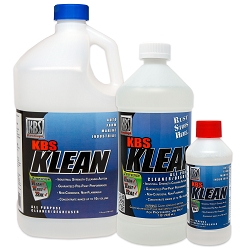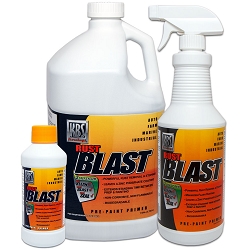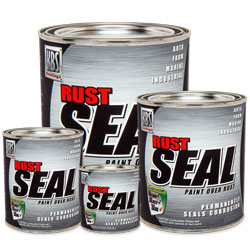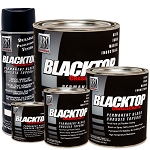


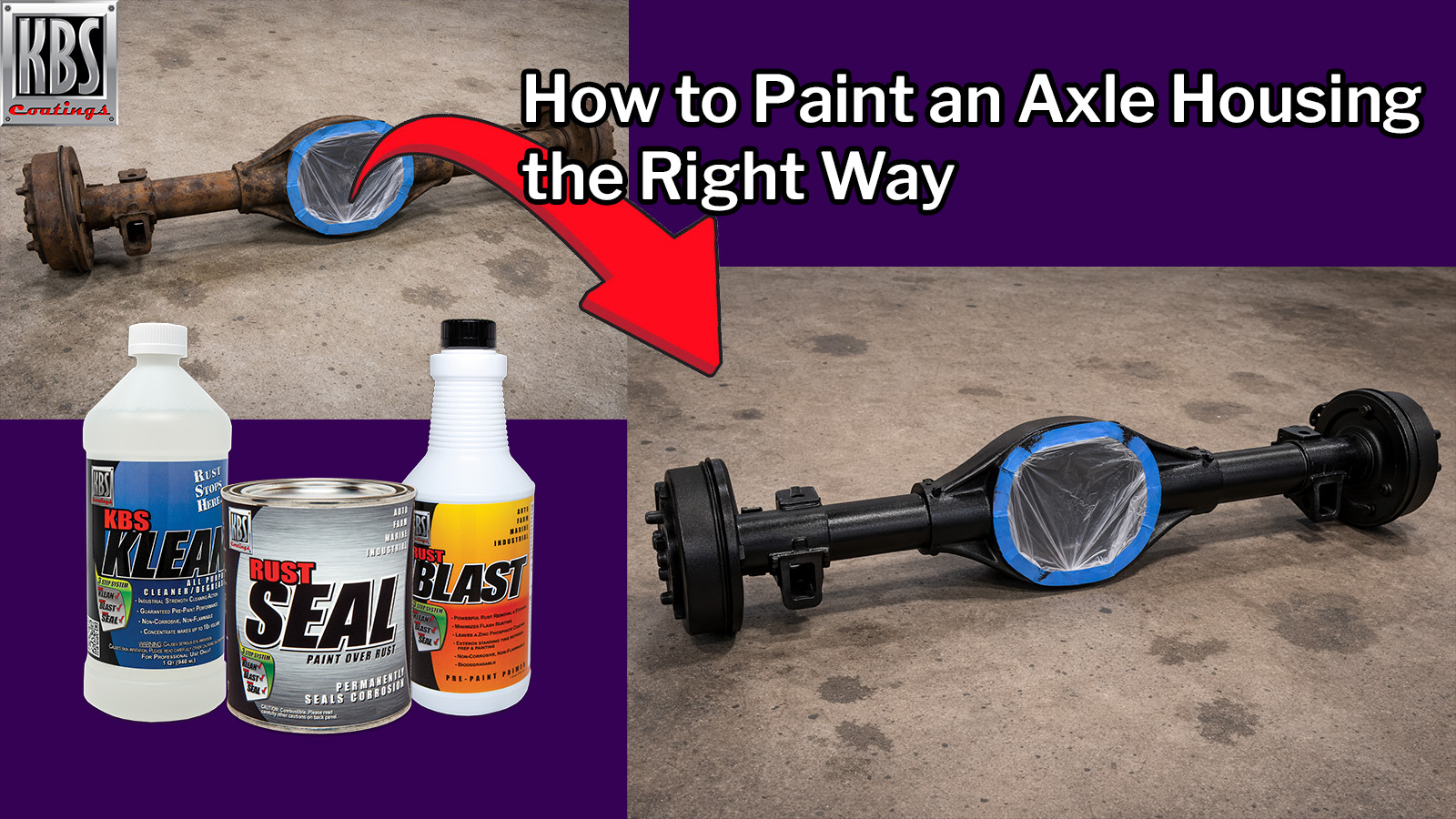
To paint an axle housing so the paint stays on, remove loose rust and old coating, degrease with KBS Klean, treat the steel with RustBlast, and seal it with two thin coats of KBS RustSeal. Most peeling traces back to oil and rust left under the paint, so prep decides how long the finish lasts.
Updated October 2026 by the KBS Coatings technical team.
- Why Does Paint Peel Off an Axle Housing?
- What Is the Best Paint for an Axle Housing?
- Can You Paint an Axle Without Removing It?
- What Do You Need to Paint an Axle Housing?
- How Do You Prep a Rusty Axle Housing for Paint?
- Step 1: Remove Loose Rust, Paint and Coating
- Step 2: Clean and Degrease Thoroughly
- Step 3: Treat the Metal With RustBlast
- How Do You Apply RustSeal to an Axle Housing?
- Do You Need a Topcoat Over RustSeal on an Axle?
- What Are the Most Common Mistakes When Painting an Axle Housing?
- Frequently Asked Questions About Painting Axles
- Proper Axle Housing Painting Prevents Rust and Peeling
| Products | KBS Klean, RustBlast and RustSeal, with an optional BlackTop or KBS Top Coater topcoat |
|---|---|
| RustBlast wet time | 30 minutes minimum on smooth or lightly rusted steel, 40 to 60 minutes on moderate rust, 1 to 2 hours on heavy rust |
| Coat after RustBlast | Within 7 days |
| RustSeal application temperature | 55 to 82°F |
| RustSeal coats | At least two thin coats, about 2 mils each |
| RustSeal recoat | After 2 to 6 hours (dry to the touch) and within 8 hours |
| RustSeal fully cured | 24 hours after the final coat |
Why Does Paint Peel Off an Axle Housing?
Paint peels off an axle housing when it cannot grip the steel: oil, rust, dirt, a coat applied too thick, or cold, humid weather during application break the bond and the finish lifts later.
Common causes include:
- Oil seepage from seals. Axle housings often weep gear oil from pinion seals, axle seals or vent tubes. Even a thin oil film prevents adhesion and causes fisheyes or peeling later.
- Rust left underneath. If loose, flaking rust is not fully removed, the coating has no solid foundation. The paint may look fine at first, then bubble or peel.
- Dirt and brake dust. Axles collect road grime, brake dust and debris. If the housing is not cleaned and degreased thoroughly, the weak bond leads to lifting, bubbling or early peeling.
- Thick coats trapping solvent. Heavy coats trap solvent beneath the surface, so the coating feels dry outside and stays soft underneath. As the solvent escapes, the finish can wrinkle, blister or separate from the metal.
- Cold or humid weather. Cold slows solvent evaporation and weakens adhesion, and high humidity affects cure. RustSeal applies best between 55 and 82°F, ideally at 30 to 80 percent relative humidity.

What Is the Best Paint for an Axle Housing?
The best paint for an axle housing is a rust encapsulating coating that bonds to bare or lightly rusted steel and resists oil, chips and moisture, such as RustSeal. RustSeal is a one-part moisture-cured urethane that cures rock hard yet flexible, and it is rated up to 600°F continuous once fully cured.
A good axle coating does eight jobs:
- Corrosion resistance. Axles face constant water, mud and road salt, so the coating must seal the steel from oxygen and moisture.
- Impact and chip resistance. Rocks, sand and debris hit axle housings, so the coating must resist gravel strikes and abrasion.
- Adhesion to steel. Axles are cast or welded steel with pits and seams, so the coating must bond to bare or lightly rusted steel and rough welds.
- Oil and chemical resistance. Gear oil, brake fluid and road contaminants should not soften the finish.
- Heat tolerance. The differential puts the housing through repeated heat cycles, so the coating must not soften, degrade or discolor.
- Flexibility. Impacts and temperature swings crack brittle coatings, so the best coatings balance hardness with some give.
- Sealing pits and seams. Rust pits, weld seams, brackets and spring perches hold moisture, so the coating must seal them. RustSeal self-levels and seals deep pitting and rust inside weld seams.
- Easy touch-up. Practical coatings can be recoated without stripping the whole housing.
Can You Paint an Axle Without Removing It?
Yes, you can paint an axle housing while it is installed, but removing it gives better coverage and a longer lasting finish, especially on the upper housing and weld seams.
In place, it is hard to aim a spray gun for full coverage, hard to avoid runs on round tubes, and hard to keep overspray off brake lines and nearby parts. Brushing is often the better method on an installed axle. RustSeal flows out and self-levels, so it brushes on smoothly without visible brush marks.
What Do You Need to Paint an Axle Housing?
You need three KBS products in order, plus a few supplies: a degreaser, a rust treatment, a rust encapsulating coating and, if the axle sees sun, an opaque topcoat.
- KBS Klean: water-based degreaser that removes oil, dirt, grease and grime without leaving a residue that blocks adhesion
- RustBlast: dissolves rust and leaves a zinc phosphate base coat for RustSeal to bond to
- RustSeal: the rust encapsulating coating, available in 11 colors
- KBS #1 Thinner (optional): skip it unless you are spraying or need to thin RustSeal
- KBS Paint Mixing Cup (optional): skip it if you are painting straight from the can
- Brush, roller or KBS HVLP spray gun (optional): brushing works for an installed axle, and a spray gun suits a housing that is out of the vehicle
- BlackTop or KBS Top Coater (optional): skip the topcoat unless the axle sees repeated direct sunlight
- Fusion Self-Etching Primer (optional): only for the primer method of preparing RustSeal for topcoating
- Chemical-resistant gloves, safety glasses and proper personal protective equipment
- Wire wheel, 320 grit sandpaper or a sandblaster, a sponge or bristle brush, and masking for vent tubes and fill holes
The Large System Sampler Kit bundles the KBS Klean, RustBlast and RustSeal system to stop rust on up to 25 sq ft. Not sure which kit fits? Use the Kit Finder.
How Do You Prep a Rusty Axle Housing for Paint?
Prep a rusty axle housing in three steps: remove loose rust and failing paint, degrease with KBS Klean, then treat the steel with RustBlast. Mask the vent tubes and fill holes first, and take off the differential cover if you can for more complete cleaning and rust removal.
Step 1: Remove Loose Rust, Paint and Coating
Use a wire wheel, 320 grit sandpaper or sandblasting to remove all loose rust, loose coating and failing paint, and pay special attention to weld seams. RustSeal needs a solid foundation for the strongest adhesion. Light surface rust can stay when you treat it with RustBlast and coat it with RustSeal.
Newly sandblasted metal (fresh, not recycled sand) that has been handled with gloved hands can take RustSeal directly. Blow off the loose dust and no other prep is needed. If a coating is still firmly adhered, scuff it with 320 grit sandpaper to give RustSeal tooth to grip.
Step 2: Clean and Degrease Thoroughly
Clean the whole axle housing with KBS Klean once the loose rust and paint are gone. Mix about 5 parts hot water to 1 part KBS Klean, scrub with a sponge or bristle brush, then rinse and dry thoroughly. See the KBS Klean directions for full instructions.

Step 3: Treat the Metal With RustBlast
Spray RustBlast full strength on the clean, dry housing and keep it wet for 30 minutes on smooth or lightly rusted steel, 40 to 60 minutes on moderate rust, and 1 to 2 hours on heavy rust. Never let it dry during that time. Scrub intermittently with a Scotch-Brite pad. Then rinse thoroughly with water, let the housing dry completely, and coat within 7 days.
RustBlast dissolves rust chemically and leaves a zinc phosphate base coat that RustSeal bonds to, so leave that base coat in place. A whitish zinc phosphate residue will remain. That residue is beneficial and helps prevent flash rust, so do not remove it. See the RustBlast directions for full instructions.

Stuck or unsure? Search the KBS Support Desk for instant answers
How Do You Apply RustSeal to an Axle Housing?
Apply RustSeal in at least two thin, overlapping coats by brush, roller or spray between 55 and 82°F. Recoat once the first coat is dry to the touch (typically 2 to 6 hours) and within 8 hours. The axle housing is fully cured 24 hours after the final coat.
RustSeal is a 1K moisture-cured urethane that cures to a rock hard, flexible film. It resists impacts and abrasion, so it holds up against chipping and peeling. It can be applied directly to rusted, treated or bare metal, and light surface rust that has been treated with RustBlast can stay under it.
- Choose your application method. Brushing, rolling or spraying all work. Brushing is often the easiest choice when the axle stays under the vehicle.
- Check the conditions. Apply between 55 and 82°F, away from rain and high humidity. Ideal humidity is 30 to 80 percent.
- Stir thoroughly. Stir from the bottom of the can to the top before use. To paint out of a KBS Paint Mixing Cup, pour what you need, and keep leftover RustSeal in a steel can or glass jar, since it deteriorates the plastic cup over time.
- Thin only if needed. Thinning is not generally required. When spraying, 5 to 10 percent is normally enough, using only KBS #1 Thinner or xylene. Never reduce RustSeal with lacquer thinner.
- Apply thin, overlapping coats. Apply at least two thin covering coats at about 2 mils each. Several thin coats beat a few thick ones.
- Recoat on time. Recoat once the previous coat is dry to the touch (typically 2 to 6 hours) and within 8 hours. If more than 8 hours pass, wait a full 24 hours, lightly scuff with 320 grit or a green Scotch-Brite pad, then recoat.
- Coat over treated rust. RustSeal can go over light surface rust that has been treated with RustBlast.
- Let it cure. RustSeal is fully cured 24 hours after the final coat. Wait for the full cure before putting the axle housing back in service.
See the RustSeal directions for full instructions.


Do You Need a Topcoat Over RustSeal on an Axle?
Topcoat RustSeal when the axle sees repeated or prolonged direct sunlight, because RustSeal is not UV stable: its color and sheen chalk and fade in the sun, although its rust protection stays fully effective. A clear coat does not fix this. Use an opaque, UV stable topcoat such as BlackTop, KBS Top Coater or KBS MAXX.
How to Prepare RustSeal for Topcoating
Choose one of three methods:
- Topcoat while RustSeal is fresh. BlackTop, KBS Top Coater and KBS MAXX can go directly over RustSeal that is between 3 and 8 hours old, with no other prep.
- Scuffing method. Let the final coat cure at least 24 hours, scuff it with 320 grit sandpaper, clean and dry the surface, then topcoat.
- Self-etching primer method. After the final coat has cured at least 24 hours, dust on a coat of Fusion Self-Etching Primer, let it cure 30 minutes, then topcoat.
Apply the topcoat between 55 and 82°F. KBS Top Coater cures in 4 to 7 days and BlackTop cures in 48 hours.
What Are the Most Common Mistakes When Painting an Axle Housing?
The most common mistakes are skipping the degreasing, painting over an active leak, coating untreated rust, applying coats too thick, and ignoring vent tube contamination.
- Skipping degreasing. Gear oil film is a common cause of peeling, so clean with KBS Klean every time.
- Painting over active leaks. Fix the leaking seal first, or new oil will lift the new coating.
- Coating untreated rust. Remove loose rust and treat the rest with RustBlast before RustSeal.
- Applying coats too thick. Use thin coats so solvent can escape and the coating cures evenly.
- Ignoring vent tube contamination. Mask the vent tube and fill holes before painting, and clean around them.
Frequently Asked Questions About Painting Axles
What kind of paint do you use on a metal trailer?
Use a rust encapsulating coating such as KBS RustSeal on the bare or lightly rusted steel, then topcoat with BlackTop or KBS Top Coater where the trailer sits in the sun. Prep the same way as an axle: clean with KBS Klean, treat rust with RustBlast, then coat. The trailer frame rust guide covers a full trailer.
How to remove rust from axles?
Knock off loose rust and scale with a wire wheel or 320 grit sandpaper, degrease with KBS Klean, then spray RustBlast full strength and keep it wet for 30 minutes to 2 hours depending on how rusty the steel is. Rinse and dry thoroughly, then coat with RustSeal within 7 days so the rust does not return.
How to paint a rear differential?
Paint the outside of a rear differential housing with the same steps as the axle tubes: mask the vent tube and fill hole, remove the differential cover if you can, degrease with KBS Klean, treat rust with RustBlast, and apply two thin coats of RustSeal. Removing the cover also keeps paint from locking the bolts in place.
How long does axle paint take to cure?
RustSeal is fully cured 24 hours after the final coat. KBS Top Coater cures in 4 to 7 days, and BlackTop cures in 48 hours.
Can you paint over surface rust on an axle?
Yes. RustSeal can be applied directly over light surface rust that has been treated with RustBlast, after the loose and flaking rust is removed.
What temperature is best for painting an axle?
RustSeal, KBS Top Coater and BlackTop apply best when the surface and the air are between 55 and 82°F.
Should the differential cover be removed first?
Removing the differential cover is recommended for more complete cleaning and rust removal. It also keeps paint from locking the bolts in place, which makes future maintenance much easier.
Still have questions? Search the KBS Support Desk for instant answers
Proper Axle Housing Painting Prevents Rust and Peeling
Painting an axle housing the right way takes three steps in order: degrease it with KBS Klean, treat the rust with RustBlast, and seal the steel with RustSeal.

Related guides: How to Fix Rust on a Truck Frame, Trailer Frame Rust Repair, Rocker Panel Rust and Hidden Rust, or browse all KBS application guides.
Tagged Products